.webp)
10 Best LMS Platforms for Frontline Workers (2026 Comparison)
The best LMS platforms for frontline employers in 2026- from Firstwork and Axonify to TalentCards and EdApp. Find the right fit for your workforce.

Why Most LMS Platforms Fail Frontline and Blue-Collar Workers
The majority of learning management systems in use today were built for desk-based employees. They assume every learner has a corporate email address, a personal laptop, and an uninterrupted hour to complete a course. Frontline and blue-collar workers have none of these.
Deskless workers make up 80% of the global workforce, according to McKinsey (2023), yet the dominant LMS category was designed entirely around the 20% who sit at desks. The result: we have compliance training that can't load on a shared Android device, onboarding flows that time out on a spotty warehouse Wi-Fi connection, and safety certifications delayed by days because the enrollment portal only runs on desktop browsers.
The delivery gap is the core problem. A construction worker waiting a week for a safety certification because a portal is processing enrollment on a desktop-first system is not an edge case. It is the default experience for frontline workers across logistics, manufacturing, healthcare, and retail.
That delay comes with a business cost. When workers can't complete compliance training on time, deployed unit counts drop. When deployed unit counts drop, revenue follows. Training infrastructure is a fundamental part of workforce infrastructure, and workforce infrastructure has a direct line to operational output.
This guide evaluates ten LMS and frontline training platforms built for the actual conditions of deskless work: mobile-first delivery, offline access, compliance-grade documentation, and the ability to onboard workers at the speed operations actually require.
This guide covers ten tools relevant to frontline and blue-collar workforce managers, what each one does well, and how to match the right tool to your actual operational problem.
Comparison Table: 10 Best LMS Platforms for Frontline and Blue-Collar Workers
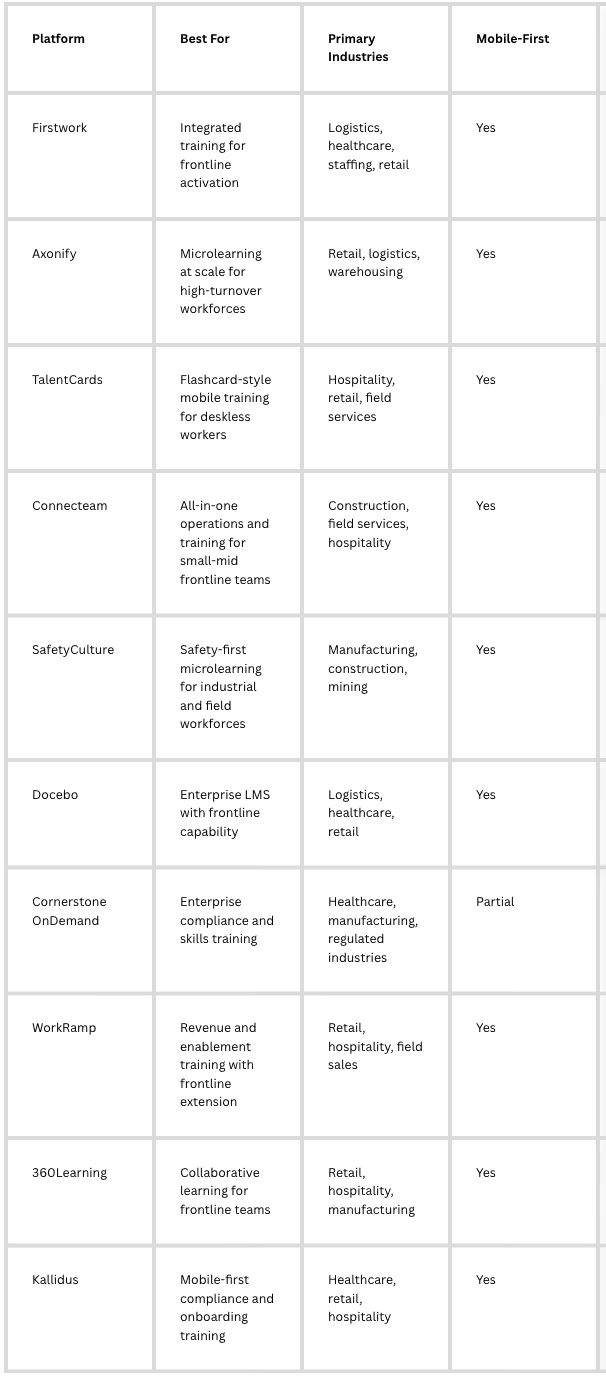
What are the 5 criteria for choosing an LMS for frontline and blue-collar workers?
These five capabilities separate tools built for frontline training from tools that were adapted for it from platforms for knowledge workers.
1. Mobile-first, no corporate email required
Frontline workers complete training on personal mobile devices, not corporate laptops. The LMS must work on any smartphone, require no corporate credentials to access, and deliver content that loads fast on variable network connections. If the platform requires IT provisioning to enroll a worker, it is not built for the frontline.
2. Microlearning and bite-sized content delivery
The platform should emphasize microlearning on a mobile-ready interface because frontline workers rely on 5-minute training windows between tasks. The platform must support short-form, modular content that can be completed in a single session on a phone. Courses designed for desktop consumption do not translate to the frontline context.
3. Compliance certification tracking with audit-ready records
Many frontline roles require mandatory certifications: food handler licenses, safety inductions, right-to-work training, hazardous materials handling, and OSHA compliance. The LMS must track completions, store certificates, and produce an audit-ready record on demand. A platform that tracks course completions without producing a compliance record is not sufficient for regulated frontline environments.
4. High-volume enrollment without manual administration
Frontline employers tend to onboard hundreds of workers in an instance, or even thousands in some industries. The LMS must handle bulk enrollment, automate assignment based on role and location, and trigger training reminders without a training manager manually managing each learner. If scaling the training program requires scaling the admin team, the platform is not built for frontline volume.
5. Integration with your HRIS, onboarding, and scheduling stack
Training that sits outside the hiring and onboarding workflow creates a manual handoff. A worker who completes onboarding but has not yet finished their mandatory training is not Day-1 ready. The LMS must connect to your existing stack so that training completion feeds downstream into worker readiness status without a coordinator tracking it manually.
Use these five criteria to evaluate every tool on this list.
What are the 10 Best LMS Platforms for Frontline and Blue-Collar Workers?
1. Firstwork
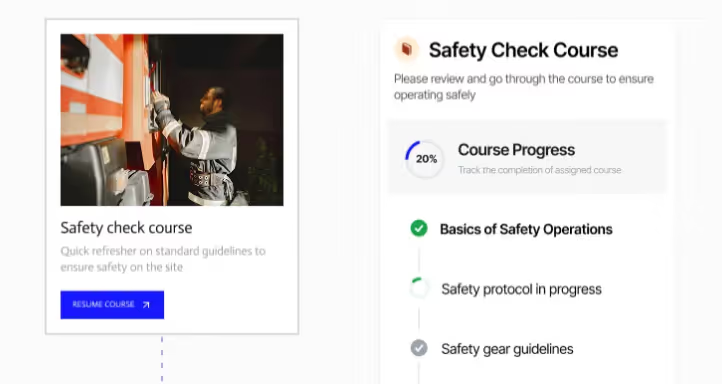
Firstwork is an AI-native frontline workforce operations platform. Training in Firstwork is embedded within the activation workflow, meaning mandatory training is assigned, tracked, and completed as part of the process that gets a worker from offer to Day-1 ready and not as a separate step that happens after onboarding is complete.
For employers where training completion is a prerequisite for the first shift, the integration is critical. Firstwork tracks both onboarding and completion of mandatory training modules in one workflow and does not mark a worker as Day 1 ready until every required step, including training, is complete.
Best for: High-volume frontline employers in logistics, healthcare, staffing, and retail. In these sectors training completion is a compliance requirement that must be verified before a worker's first shift. Hence, onboarding and training need to run as one connected workflow rather than two separate systems.
Key differentiator: Training embedded within activation. Firstwork does not separate onboarding and training into two systems. Compliance certifications, document verification, background screening, and training completions all feed into a single worker readiness status. Every training completion is logged and auditable.
What to evaluate: Firstwork's training capability is purpose-built for compliance-linked activation workflows. If your primary requirement is a standalone LMS with broad content authoring, a large pre-built course library, or extended learning paths for existing workers beyond initial onboarding, assess whether Firstwork's training features cover that scope or whether a dedicated LMS alongside Firstwork's activation platform better serves your needs.
2. Axonify
Axonify is a microlearning platform built specifically for frontline workforces in retail, logistics, and warehousing. Its core product is a daily training model: short, adaptive knowledge checks delivered to workers through a mobile app, designed to fit into the natural rhythm of a shift rather than requiring dedicated training time.
The platform uses spaced repetition and reinforcement science to improve knowledge retention in high-turnover environments where workers cycle through roles frequently. For employers whose primary training challenge is keeping a large, rotating workforce consistently informed and compliant, Axonify addresses that problem directly.
Best for: Retail, logistics, and warehousing employers managing large, high-turnover frontline workforces where daily knowledge reinforcement is the primary training goal.
Key differentiator: Adaptive microlearning that delivers short daily training bursts based on each worker's individual knowledge gaps, improving retention without requiring dedicated training sessions.
What to evaluate: Axonify is optimized for ongoing knowledge reinforcement. If your primary requirement is initial compliance certification for new hires rather than continuous training for existing workers, assess whether Axonify's onboarding training capabilities match that use case
3. TalentCards
TalentCards is a mobile-first training platform that delivers content in a flashcard format, designed for workers who have no corporate email address, no desktop access, and limited time for formal training. Workers access their training through a QR code or SMS link on any personal mobile device.
The platform is built for simplicity at the content creation and delivery layer. Managers create short card-based training decks, assign them to workers, and track completions from a central dashboard. For employers whose primary challenge is reaching deskless workers who are difficult to enroll in traditional LMS platforms, TalentCards removes that barrier directly.
Best for: Small to mid-size frontline employers in hospitality, retail, and field services who need a simple, fast-to-deploy training tool that workers can access on personal devices without IT involvement.
Key differentiator: QR code and SMS-based access that eliminates the enrollment friction of traditional LMS platforms. Workers access training instantly on any device with no app download or corporate credentials required.
What to evaluate: TalentCards is designed for simplicity. If your training requirements include complex compliance certification workflows, multi-module course structures, or deep analytics, assess whether TalentCards' feature set covers that scope.

4. Connecteam
Connecteam is an all-in-one workforce management platform that combines training, communication, scheduling, and task management in a single mobile app. Its LMS capability is embedded within a broader operational platform rather than offered as a standalone training product.
For employers who need to consolidate multiple point solutions into one platform, Connecteam provides training alongside the other day-to-day operational tools a frontline team uses. Workers interact with their schedule, training assignments, and team communications in the same app.
Best for: Small to mid-size frontline employers in construction, field services, and hospitality who want training integrated into a broader workforce operations platform rather than as a separate tool.
Key differentiator: Training, scheduling, time tracking, and team communication in one app. Workers complete training in the same platform they use for their daily operations, reducing context-switching and improving completion rates.
What to evaluate: Connecteam's training capability is part of a broader platform. If your primary requirement is a dedicated LMS with advanced compliance tracking, deep content authoring, or enterprise-scale reporting, assess whether Connecteam's training features meet that depth
5. EdApp by SafetyCulture
EdApp, now part of the SafetyCulture platform, is a microlearning LMS built for safety-critical frontline environments: manufacturing, construction, mining, and field operations. Its content library includes pre-built safety and compliance courses, and the platform integrates with SafetyCulture's broader inspection and incident management tools.
For employers in industries where safety certification is a regulatory requirement and a Day-1 prerequisite, EdApp delivers compliance training at the speed and format those workers need. The free tier makes it accessible to employers who need to deploy training quickly without a procurement cycle.
Best for: Manufacturing, construction, mining, and field operations employers where safety certification and compliance training are regulatory requirements that must be completed before workers can begin work.
Key differentiator: Pre-built safety and compliance course library with SafetyCulture integration. Safety training, inspection checklists, and incident reporting can all run within the same platform ecosystem.
What to evaluate: EdApp's strength is safety-specific compliance training. If your training requirements extend significantly beyond safety into skills development, onboarding, or sales enablement, assess the breadth of EdApp's content and authoring capabilities against those needs.

6. Docebo
Docebo is an enterprise-grade LMS used across logistics, healthcare, and retail for large-scale workforce training. It covers formal learning, informal learning, and on-the-job learning in a single platform, with strong mobile capabilities and AI-powered content recommendations.
For large enterprises that need a single LMS to serve both their knowledge worker and frontline worker populations, Docebo provides the scale and configurability to handle both. Its mobile app supports offline learning, which is relevant for workers in environments with limited connectivity.
Best for: Large enterprises in logistics, healthcare, and retail that need an enterprise-grade LMS capable of serving both frontline and corporate workforces from a single platform.
Key differentiator: Enterprise scale with strong mobile and offline capability. AI-powered content recommendations surface relevant training for each worker based on their role and learning history.
What to evaluate: Docebo is an enterprise platform with corresponding implementation complexity and cost. If your organization is a mid-size frontline employer looking for a fast-to-deploy, low-administration training tool, assess whether Docebo's implementation requirements match your operational reality.
7. Cornerstone OnDemand
Cornerstone OnDemand is one of the most established enterprise LMS platforms in the market, used widely in healthcare, manufacturing, and other regulated industries where compliance training is a legal requirement. Its compliance management capabilities are among the deepest in the category.
For employers in highly regulated frontline environments where training completion must be documented, verified, and produced on demand for auditors, Cornerstone provides the compliance infrastructure to meet that standard at scale.
Best for: Large enterprises in healthcare, manufacturing, and regulated industries where compliance training documentation, audit readiness, and regulatory reporting are primary requirements.
Key differentiator: Deep compliance management with audit-ready reporting. Cornerstone is built to satisfy regulatory requirements across complex, multi-jurisdiction organizations.
What to evaluate: Cornerstone is an enterprise platform with significant implementation investment. The mobile experience, while functional, is not as optimized for frontline workers as purpose-built frontline LMS tools. Assess the mobile UX against your frontline workforce's actual device and connectivity context before committing.

8. WorkRamp
WorkRamp is a learning platform originally built for revenue team enablement that has extended into frontline worker training, particularly in retail, hospitality, and field sales contexts. Its content authoring tools are strong, and the platform supports both formal and informal learning paths.
For employers whose training requirements span both a frontline workforce and a corporate or sales team, WorkRamp provides a single platform that can serve both populations without maintaining separate training systems.
Best for: Retail, hospitality, and field sales employers who need a training platform that serves both frontline workers and corporate or revenue teams from a single system.
Key differentiator: Strong content authoring and enablement tooling that extends to frontline contexts. Employers who have already deployed WorkRamp for corporate training can extend it to the frontline without introducing a new vendor.
What to evaluate: WorkRamp's frontline capabilities are an extension of a corporate enablement platform rather than a purpose-built frontline product. If your primary workforce is frontline and your training requirements are compliance-heavy, assess whether WorkRamp's compliance tracking depth meets your regulatory requirements.
9. 360Learning
360Learning is a collaborative learning platform that emphasizes peer-generated content and social learning alongside formal training. Workers and managers can create, share, and comment on training content, making it well-suited to environments where frontline knowledge is distributed across experienced workers rather than concentrated in a central L&D team.
For employers in retail, hospitality, and manufacturing where experienced workers are often the best source of role-specific training content, 360Learning provides the tools to capture and distribute that knowledge at scale.
Best for: Retail, hospitality, and manufacturing employers where peer-to-peer knowledge sharing and manager-created content are as important as formal training delivery.
Key differentiator: Collaborative content creation that enables frontline workers and managers to build and share training content, not just consume it. Peer learning at scale without requiring a dedicated L&D team to author every course.
What to evaluate: 360Learning's collaborative model works best in environments where experienced workers are willing and able to contribute content. If your training requirements are primarily compliance-driven, with mandatory certifications that must come from verified sources rather than peer-generated content, assess whether 360Learning's compliance tracking capabilities meet that standard.
10. Kallidus
Kallidus is a mobile-first LMS focused on compliance training, onboarding, and performance management for frontline workforces in healthcare, retail, and hospitality. Its compliance course library is strong, and the platform is designed to deliver training at the speed that frontline hiring demands.
For healthcare employers managing mandatory clinical training and retail employers managing food safety and customer service compliance, Kallidus provides a purpose-built training environment with the compliance depth those sectors require.
Best for: Healthcare, retail, and hospitality employers where mandatory compliance training is a Day-1 prerequisite and where a mobile-first, compliance-focused LMS is the primary requirement.
Key differentiator: Strong compliance course library with mobile-first delivery. Kallidus is built around the compliance training needs of healthcare and retail rather than adapting a corporate LMS for frontline use.
What to evaluate: Verify current product capabilities and integration depth directly with Kallidus before committing, particularly if your requirements span multiple regulated sectors with different compliance frameworks.
How to Choose an LMS for Frontline Workers: Match the Tool to Your Actual Training Bottleneck
The right platform is determined by where your training process is actually breaking down. The usual suspects are low completions, missed compliance certifications, or workers arriving on Day 1 without the training they need.
Use this framework before you book a demo.
If your bottleneck is daily knowledge retention for high-turnover workers: Your workforce is large, rotates frequently, and knowledge fades between shifts. Axonify is built for this problem.
If your bottleneck is reaching workers who have no corporate email or device: Your workers cannot access traditional LMS enrollment flows. TalentCards removes that barrier with QR code and SMS-based access.
If your bottleneck is too many point solutions for a small team: You need training, scheduling, and communication in one place. Connecteam consolidates those tools.
If your bottleneck is safety certification for industrial and field workers: Safety compliance is a Day-1 legal requirement in your industry. EdApp by SafetyCulture is purpose-built for this context.
If your bottleneck is serving both frontline and corporate workforces from one platform: You need enterprise scale across multiple worker populations. Docebo or Cornerstone OnDemand handle both.
If your bottleneck is regulatory compliance documentation in a highly regulated industry: healthcare, manufacturing, or another regulated sector where training records must satisfy auditors. Cornerstone OnDemand provides the compliance depth for this requirement.
If your bottleneck is peer knowledge sharing alongside formal training: Experienced workers hold the most valuable training content. 360Learning captures and distributes it.
If your bottleneck is compliance-focused mobile training for healthcare or retail: Mandatory certifications delivered at frontline speed. Kallidus is built for this operating context.
If your bottleneck is training sitting outside the onboarding and activation workflow: Workers complete onboarding, but their training is tracked in a separate system.
Mandatory training is not a prerequisite for the first shift. Compliance certifications are not verified before Day 1.
Firstwork embeds training within the activation workflow so that onboarding and training completions feed into a single worker readiness status. A worker is not Day-1 ready until every required step is done.
Frequently Asked Questions: LMS for Frontline and Blue-Collar Workers
Q: What is the best LMS for frontline workers in 2026? There is no single best LMS for every frontline employer. The right platform depends on the bottleneck. For daily microlearning in high-turnover environments, choose Axonify. For deskless workers with no corporate device, choose TalentCards. For safety-critical compliance, EdApp by SafetyCulture is the right choice. For training embedded within activation and onboarding, the software to go for is Firstwork. Match the tool to the operational gap.
Q: What is an LMS for frontline workers? An LMS for frontline workers is a training platform designed for deskless, shift-based, and hourly employees. It delivers training on mobile devices, supports offline access, handles bulk enrollment without manual administration, and tracks compliance certifications with audit-ready records. It is distinct from corporate LMS platforms, which assume desktop access, corporate email, and dedicated training time.
Q: How is a frontline LMS different from a corporate LMS? A frontline LMS is built for workers with no desk, no corporate device, and limited training windows. Content is delivered in short modules on personal mobile devices. Enrollment is triggered automatically by role or location. Compliance certifications are tracked against regulatory requirements specific to frontline industries. Corporate LMS platforms typically assume the opposite conditions and do not adapt well to frontline operational realities.
Q: How much does an LMS for frontline workers cost? Pricing varies significantly by platform and scale. TalentCards, Connecteam, and 360Learning offer per-user per-month pricing starting from approximately $2 to $5 per user. EdApp by SafetyCulture offers a free tier for basic usage. Enterprise platforms, including Docebo, Cornerstone OnDemand, WorkRamp, and Kallidus, use quote-based pricing tied to organization size and module scope. Confirm current pricing directly with each vendor before making a procurement decision.
Q: Can a frontline LMS handle compliance certification tracking? Yes, but depth varies significantly. Platforms like Cornerstone OnDemand, EdApp by SafetyCulture, and Kallidus are built around compliance certification tracking with audit-ready records. Others, like TalentCards and Connecteam, track course completions but may not produce the documentation format required for regulatory audits in healthcare, construction, or food service. Always verify compliance tracking capabilities against your specific regulatory requirements before purchasing.
Q: Does an LMS integrate with onboarding and HRIS systems? Most enterprise LMS platforms offer integrations with major HRIS and ATS systems. The depth of those integrations varies. The critical question is whether training completion automatically updates workers. readiness status in your HRIS or onboarding platform, or whether it requires a manual sync. Firstwork is the only platform on this list where training completion is natively embedded within the activation workflow and updates worker readiness status automatically.
Q: What is microlearning, and why does it matter for frontline training? Microlearning is a training approach that delivers content in short, focused modules typically lasting two to five minutes. It matters for frontline workers because their training windows are short, their roles are task-specific, and knowledge retention improves when content is delivered in small, repeatable doses rather than long sessions. Platforms like Axonify and TalentCards are built specifically around the microlearning model.
See How Firstwork Connects Training to Worker Activation
Firstwork makes training completion a prerequisite for Day 1 readiness.
It ensures:
- Documents are verified.
- Compliances are cleared.
- The background check is complete.
- Training is completed
These factors enable the worker to be Day 1 ready. All in one workflow, all in one audit trail.
See Firstwork in action here.