.webp)
What Are the Top 10 AI Callers for SMBs and Enterprise Use
The top AI callers for staffing agencies in 2026- Bland AI, Synthflow, Kixie, and more. See what each does and the one question to ask before signing.
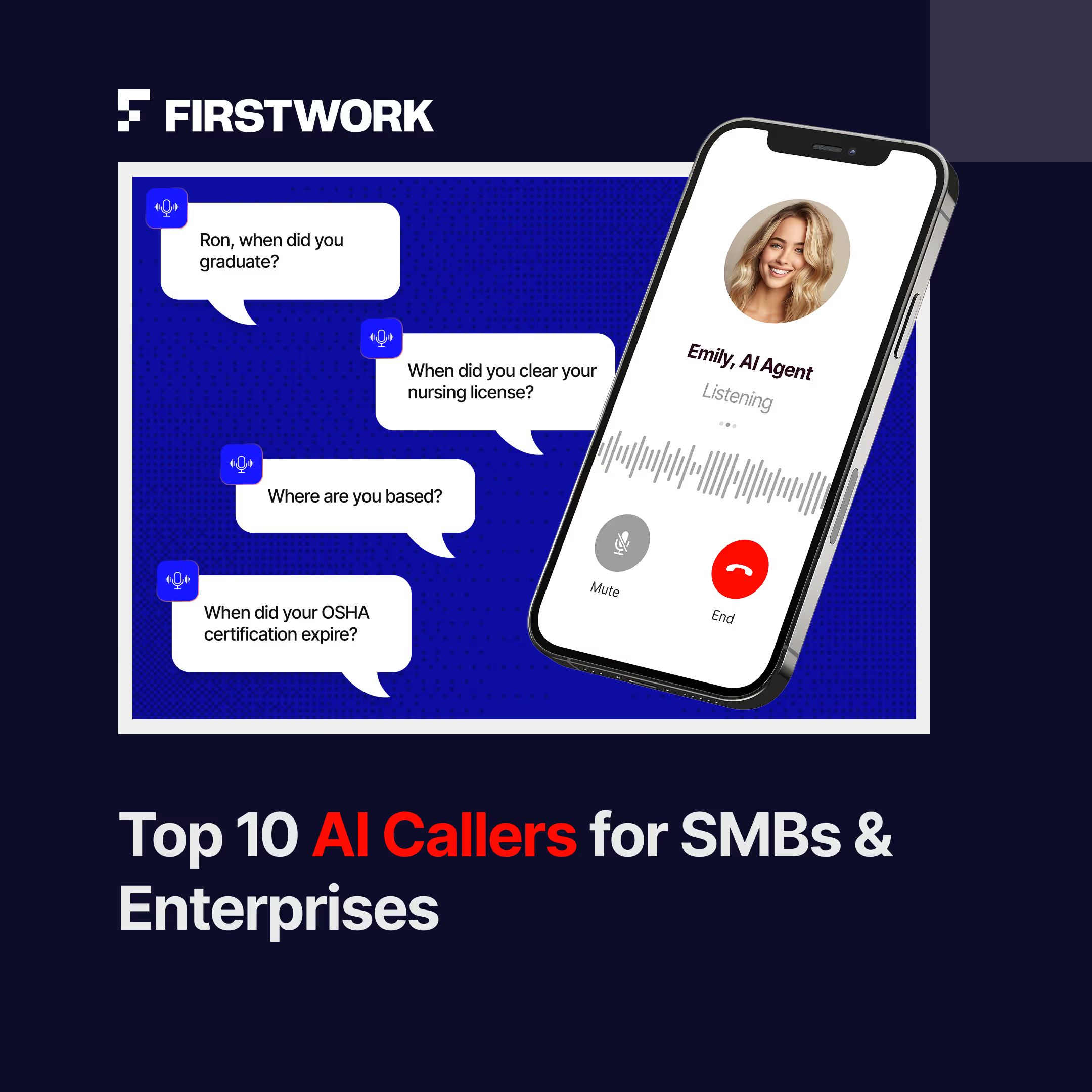
What is an AI caller?
An AI caller is an automated voice or conversational AI tool that contacts candidates on behalf of a recruiting or staffing team. Using natural language processing and voice synthesis, AI callers can screen applicants, schedule interviews, send reminders, collect documents, and follow up without a human coordinator making each call manually.
In 2026, AI callers range from simple power dialers with AI-assisted scripts to fully autonomous voice agents capable of holding multi-turn conversations, handling objections, and escalating to a human when needed.
The best AI callers for frontline staffing agencies do three things well:
- Speed: candidate outreach within minutes of an offer as opposed to hours
- Persistence: automated multi-touch follow-up sequences that do not give up after one attempt
- Handoff logic: knowing when to escalate to a human coordinator and when to keep the automation running
Why AI callers matter
Candidate drop-off between offer and first shift is one of the most expensive problems in frontline staffing. Industry-wide annual loss reported to be close to 2.3 billion USD, specific to staffing*. The gap is caused by a lack of timely, consistent follow-up.
AI callers close that gap by automating the outreach that coordinators do not have time to do manually, at scale, without adding headcount. Agencies using AI calling tools report improvements in fill rates, reductions in no-shows, and faster time-to-first-shift across their candidate pipelines.
Most AI callers are built for the top of the funnel: sourcing and screening. There is a clear dearth of AI callers that are built for what happens after the offer, which is where most candidate drop-off actually occurs.
Comparison table
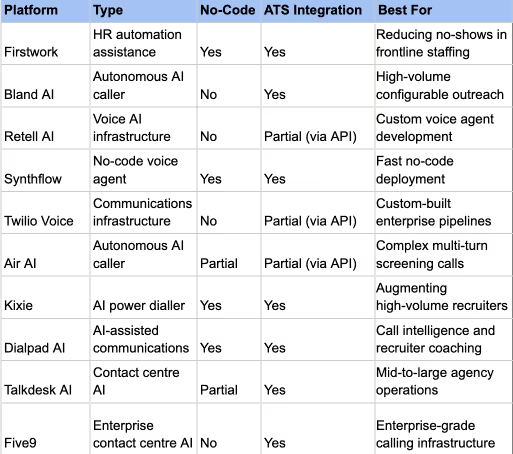
What are the top 10 AI callers?
1. Firstwork
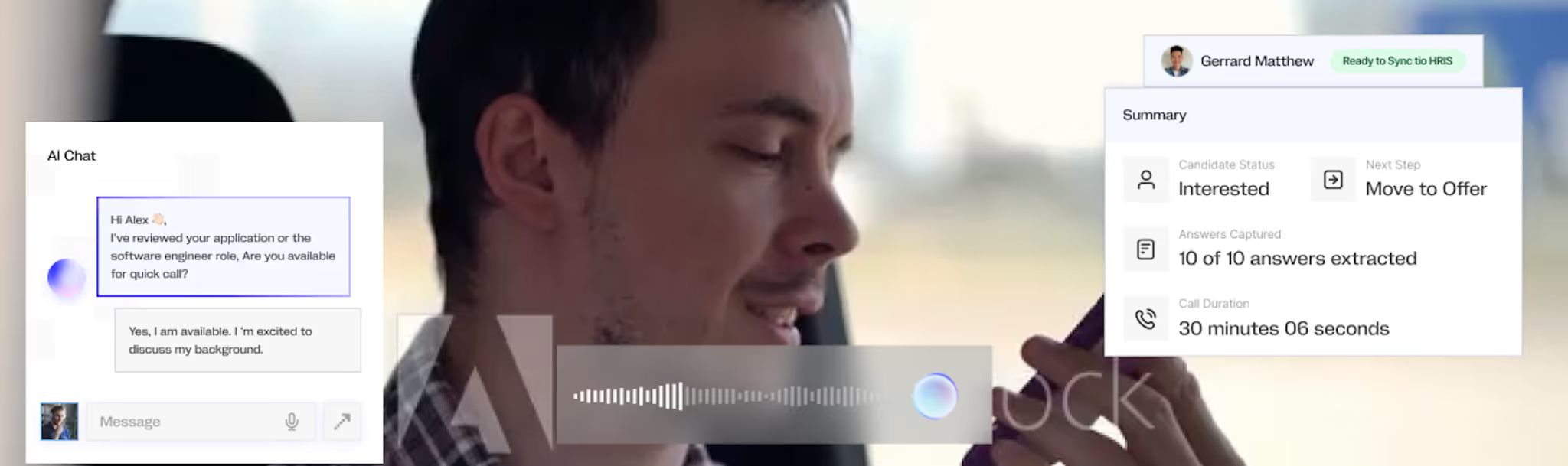
Firstwork is built to solve the offer-to-first-shift problem in frontline staffing. Firstwork’s AI caller helps across different stages of hiring: offer acceptance, automation of follow-up sequences, document collection, onboarding reminders, and compliance verification. The caller is a key cog of the machinery that minimizes candidate drop-off in the days between the offer and day one.
The result is measurable: staffing agencies using Firstwork report higher fill rates, fewer no-shows, and faster worker activation, without adding headcount to their coordination teams.
Key features: post-offer AI outreach, automated document collection, onboarding nudges, compliance verification, no-show reduction, ATS integration.
Best for: Frontline-specific staffing agencies, logistics operators, healthcare providers, and hospitality businesses that need to activate frontline workers at speed and scale.
2. Bland AI
Bland AI is one of the most widely deployed AI calling platforms in North America and a strong choice for agencies that need high call volumes and deep configurability. In 2026, Bland supports real-time interruption handling, multilingual outreach across 30+ languages, and live call transfers to human agents. Its API-first architecture integrates with most ATS and CRM stacks, though meaningful configuration is required to build staffing-specific workflows.
Key features: real-time interruption handling, multilingual support, live call transfer, ATS and CRM integrations, and programmable call logic.
Best for: Agencies with technical resources who need a high-volume, configurable AI calling engine.

3. Retell AI
Retell AI has become the preferred infrastructure layer for teams building custom voice agents. Latency improvements in late 2025 made its conversations feel significantly more natural. Retell now supports multi-step workflows, conditional branching, and post-call data extraction directly into ATS platforms. It remains developer-heavy, but a growing ecosystem of pre-built staffing templates is reducing build time.
Key features: low-latency voice AI, conditional call logic, post-call data extraction, developer API, and pre-built recruiting templates.
Best for: Tech-forward agencies and recruitment platforms building proprietary AI calling tools on top of a reliable voice infrastructure.
4. Synthflow
Synthflow is the leading no-code AI voice agent builder in 2026. Its platform includes pre-built recruiting workflows, drag-and-drop call logic, and native integrations with Bullhorn, Greenhouse, and Workday. The trade-off is depth: complex conditional logic and compliance-heavy workflows sometimes require workarounds that slow deployment.
Key features: no-code workflow builder, pre-built recruiting templates, Bullhorn and Greenhouse integrations, inbound and outbound support.
Best for: Mid-sized staffing agencies that want to launch an AI caller quickly without relying on a development team.
5. Thoughtly
Thoughtly has earned a loyal following in recruiting and staffing since its breakout in 2025. Its visual call flow builder is among the most intuitive on the market. The platform handles both inbound candidate inquiries and outbound outreach, supports calendar integrations for automated interview scheduling, and logs call data cleanly into CRM systems.
Key features: a visual call flow builder, inbound and outbound calling, calendar scheduling integration, CRM logging, and an HR-focused product roadmap.
Best for: Agencies prioritizing ease of use, fast setup, and clean integration with their existing CRM.
6. Air AI
Air AI leads the market in long-duration autonomous conversations. In 2026 it supports calls of 10 to 40 minutes without human intervention, making it well suited to complex, multi-turn candidate conversations. Its strength is in professional and technical recruiting, where nuanced dialogue matters. Adoption in high-volume frontline staffing is growing but slower, as the conversational depth exceeds what most rapid-placement workflows require.
Key features: long-duration autonomous calls, multi-turn conversation handling, high conversational fidelity.
Best for: Agencies handling consultative, complex candidate conversations at scale, particularly in professional and technical hiring.
7. Kixie (AI Power Dialer)
Kixie remains a reliable choice for high-volume outbound recruiting teams in 2026. Its AI enhancements include automated voicemail drops, local presence dialing, real-time call coaching prompts, and post-call AI summaries. It sits at the human-assisted end of the AI caller spectrum, which suits agencies that want to accelerate recruiter activity rather than replace it.
Key features: parallel dialing, AI voicemail drop, local presence, real-time coaching, CRM auto-logging, and post-call summaries.
Best for: High-volume sourcing teams that want to increase recruiter productivity without removing the human from the conversation.
8. Salesfinity
Salesfinity built its reputation on a parallel dialer that dramatically increases outbound call volume. In 2026, it added AI-powered call scripts, live objection-handling prompts, and automated follow-up sequencing. It bridges the gap between a traditional power dialer and a fully autonomous AI caller, popular with agencies where first-contact speed drives placement rates.
Key features: parallel dialing, AI call scripts, objection-handling prompts, automated follow-up sequences, and pipeline reporting.
Best for: Agencies running high-velocity outbound sourcing campaigns where speed of first contact is the primary metric.

9. NICE CXone (AI-assisted)
NICE CXone has deepened its AI capabilities in 2026, adding generative AI across its contact center suite. For large staffing operations managing significant candidate service volumes, it offers workforce management, AI-assisted agent coaching, and omnichannel engagement across voice, chat, and email. It is comprehensive but purpose-built for contact centers, not recruiting operations.
Key features: generative AI integration, omnichannel engagement, workforce management, AI agent coaching, enterprise-grade compliance.
Best for: Large staffing enterprises already in the NICE ecosystem that need contact center-grade infrastructure for candidate communications.

10. HireVue (AI voice screening)
HireVue has expanded beyond video interviewing into AI-driven voice screening in 2026. Candidates receive automated screening calls assessed against structured competency frameworks. It is compliance-heavy and well-suited to regulated industries. The pace and informality of frontline and light industrial staffing makes it a poor fit for most agency environments.
Key features: AI voice screening, competency-based assessment, compliance documentation, structured hiring frameworks.
Best for: Corporate HR teams and RPO providers running structured, high-volume hiring programs in regulated industries.
Quick comparison: Which AI caller is right for you?
- High-volume configurable outreach: Bland AI
- Building a custom voice agent: Retell AI
- No-code fast deployment: Synthflow
- Ease of use and CRM integration: Thoughtly
- Complex multi-turn conversations: Air AI
- Augmenting human recruiters: Kixie
- Outbound sourcing campaigns: Salesfinity
- Enterprise contact centre operations: NICE CXone
- Structured corporate screening: HireVue
- Offer-to-first-shift automation for frontline staffing: Firstwork
Frequently asked questions about AI callers
What is an AI caller?
An AI caller is an automated tool that uses voice AI and natural language processing to contact candidates on behalf of a team. It can handle screening, scheduling, follow-up, reminders, and document collection without a human making each call. In staffing, AI callers are used to increase outreach volume, reduce manual coordinator workload, and improve candidate engagement throughout the hiring process.
What is the best AI caller for staffing agencies in 2026?
The best AI caller depends on which part of the funnel you are automating. For post-offer automation and reducing candidate drop-off, Firstwork is the only platform built specifically for the offer-to-first-shift problem in frontline staffing. For high-volume outbound sourcing, Bland AI and Salesfinity are strong choices. For no-code deployment, Synthflow leads the market.
How do AI callers reduce candidate drop-off?
AI callers reduce candidate drop-off by automating the follow-up touchpoints that human coordinators cannot complete at scale. After a candidate accepts an offer, an AI caller can immediately send confirmation, collect required documents, send onboarding reminders, and follow up if a candidate goes quiet, all without coordinator involvement. Platforms like Firstwork are purpose-built for this post-offer automation workflow.
What is the difference between an AI caller and a power dialler?
A power dialer automates the dialing process but still requires a human to handle the conversation. An AI caller replaces the human in the conversation entirely, using voice AI to speak with candidates, respond to questions, and complete structured workflows autonomously. Some platforms, like Kixie and Salesfinity, sit in between, using AI to assist human callers rather than replace them.
Can AI callers integrate with staffing ATS platforms?
Yes. Most leading AI callers in 2026 offer integrations with major staffing ATS platforms, including Bullhorn, Greenhouse, Workday, and JobAdder. Synthflow and Thoughtly offer native integrations. Bland AI and Retell AI support integrations via API. Firstwork is designed to integrate with the ATS and onboarding infrastructure used by frontline staffing agencies.
How much do AI callers cost?
AI caller pricing in 2026 varies significantly by platform and usage volume. Developer-focused tools like Retell AI and Bland AI typically charge per minute of call time, ranging from $0.05 to $0.15 per minute. No-code platforms like Synthflow and Thoughtly offer monthly subscription plans starting from around $500 per month. Enterprise platforms like NICE CXone require custom pricing. Contact each vendor directly for current pricing.
See how Firstwork automates the offer-to-first-shift gap
Firstwork's AI agents handle every touchpoint between offer acceptance and first shift, automating follow-up, document collection, onboarding nudges, and compliance verification. Staffing agencies using Firstwork reduce no-shows, improve fill rates, and activate workers faster without adding headcount.
Book a demo at firstwork.com