.webp)
How to cut Frontline Activation Time by 99% | Firstwork
A practical 90-day AI playbook for staffing leaders to slash frontline activation time, recover margin, and get workers paid faster.
Staffing operations leaders face a $170M+ margin crisis. With U.S. staffing revenue contracting 10% year over year and nearly 2.5 million temporary workers moving through staffing firms each week, the industry is leaking margins due to manual onboarding, missed shifts, and audit failures. Roughly 95% of enterprise AI pilots produce no measurable P&L impact. It’s clear that this amazing technology hasn’t yet been fully adopted across every pocket of the economy, and not many CEOs have a fully formed AI strategy.
But why do 95% of AI pilots fail?
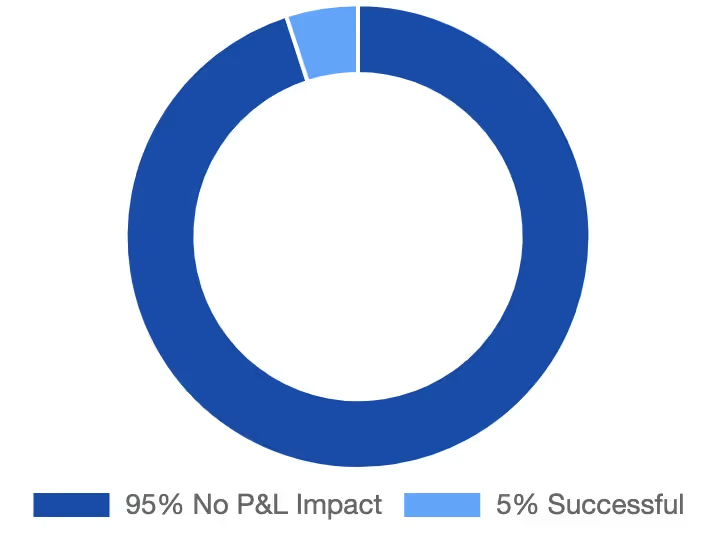
Most AI pilots fail to deliver measurable value, not because the technology is weak, but because they are scoped as experiments rather than operational programs. The real blockers aren't the models, they are:
Integration: Lack of connection to existing workflows.
Ownership: No clear operational owner with P&L responsibility.
Workflow design: Failure to redesign the process around the applicant rather than the existing tech.
The frontline workforce industry is no different and is plagued with the same issues. For business and operations leaders, fixing this is the single biggest operational lever for recovering margin and protecting customer service.
AI with proof, not promises
AI hype lives in slide decks; real value lives where money and people move. Most enterprise AI pilots fail to deliver P&L impact, not because the models are weak, but because they are scoped as experiments instead of operational programs.
Useful pilots target a single, high-friction workflow (e.g., document capture, verification, payroll enablement) and tie every change to business KPIs such as median time-to-activate, manual review hours saved, or reductions in audit exceptions.
It is advisable to run the pilot as an ops project (not a marketing proof-point) with an explicit owner, daily telemetry, defined gates, and a rollback plan. When you measure the tail (90th percentile time-to-activate), not just the median, you expose the exceptions that cost the most.
Check out the case study: How Wonolo achieved 99% faster onboarding with FirstWork
Demand agentic automation
Agentic automation is a software system that directly executes decisions, rather than merely suggesting them. This AI technology handles various tasks such as Optical Character Recognition (OCR), data validation, and API lookups. It applies predefined rules, maintains audit records, and can automatically approve low-risk cases. For exceptions, it routes them to human operators for their judgment.
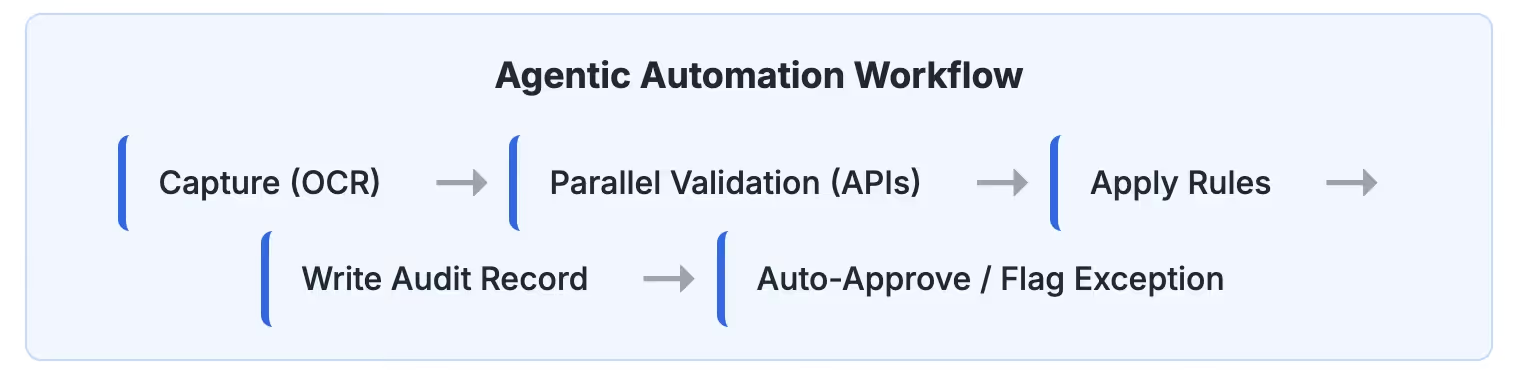
This cascade (automated action + auditable output + downstream sync) consistently shortens lead times. If a vendor cannot demonstrate end-to-end decisioning and exportable logs, be skeptical.
In procurement, insist the vendor demonstrates three things live:
- Parallelized verification that shortens the critical path.
- Safe auto-approval rules for low-risk cases.
- Exportable audit logs for regulators.
To design a pilot that prioritizes speed and scalability, focus on a single role and geographical area. Establish five key performance indicators (KPIs) from the outset, along with clear pass/fail thresholds. If the automation cuts median time-to-activate dramatically, reduces manual hours, and produces clean audit exports, you’ve moved from promise to proof, and you can justify scaling the work across regions and roles.
Industry experts believe that agentic AI and frictionless UX are the engine, and compliance is the gearbox. Your process must be engineered for the applicants, auditable, and capable of changing gears mid-season without stopping operations.
Pro tip: Don’t buy features; buy measurable flows. Ask for runbooks over slide decks, detailing vendor support for adoption, rule tuning, and exception reduction.
Compliance reimagined for 2026
Regulation is a core design constraint and is often where processes start coming apart at the seams. Compliance must be built into your hiring workflows, not tacked on as an afterthought when audits loom overhead. Treat compliance as a product requirement from day 1, and embed a perpetual compliance mechanism into every workflow you create.
Here’s a list of expert-recommended steps to make your workflows timeless:
Auditable decision records
Every automated decision must have an auditable record:
- Identity of the tool or user.
- Input artifacts used (document hashes, vendor responses).
- Model or rule version and confidence score.
- Outcome (pass/flag/fail) and human override rationale.
Pro tip: Store these records in a searchable, exportable form. For high-risk systems, your audit trail must also include risk assessments, dataset governance notes, and a versioned evidence chain (per the EU's AI Act and similar laws).
Verification matrix & response
Map the regulatory surface for every geography and role. Create a "verification matrix" that tracks credential type, authoritative source, integration method, expected TAT, and fallback.
Treat this as a living config. Your system must be able to toggle rules, add data sources, or put a region on "policy hold" in hours. Include opt-out and notice flows in candidate-facing UX to comply with state-level consumer protection laws (e.g., Colorado's SB24-205).
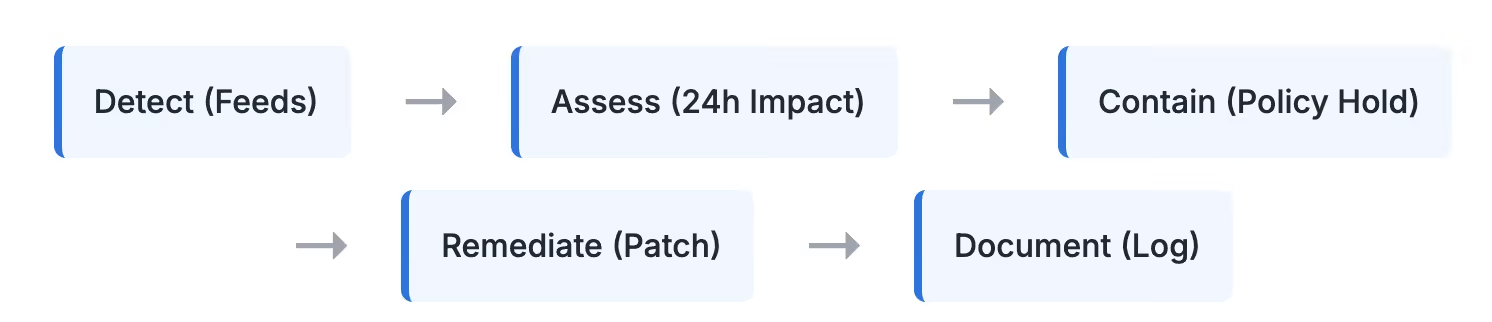
A crucial next step involves planning an emergency compliance sprint. Without a well-defined playbook, sudden mid-season rule changes, such as those from DOT/FMCSA, can have catastrophic consequences. Therefore, this sprint must encompass several key actions:
- Detection: Subscribe to regulatory feeds and vendor alerts to promptly identify changes.
- Assessment: Evaluate the impact of changes on active and incoming hires within 24 hours.
- Containment: Implement a safe rule toggle or policy hold to mitigate immediate risks.
- Remediation: Patch rules and notify affected candidates to address the changes.
- Documentation: Maintain an incident log and conduct a post-mortem analysis for future reference and improvement.
Pro tip: Assign a single compliance incident owner and enforce a 72-hour assessment window.
Audit vendor contracts
Operationalize bias audits and candidate notices upfront. Where independent bias audits are required, treat it as an ongoing program that schedules annual reviews, publishes a public summary, and keeps remediation plans visible. Use audits to measure disparate impact and reduce exception rates, not just as a checkbox.
It's recommended to tie vendor contracts to compliance outcomes. Your SLAs must include verifiable TATs for third-party checks, data retention clauses for audit exports, breach and change-notice windows, and indemnities for faulty vendor data that cause activation errors.
Here’s a practical compliance checklist (use this in your runbook)
- Inventory automated decisions.
- Define required audit fields.
- Map verification sources and TATs.
- Implement rule toggle and policy-hold controls.
- Schedule the first independent bias audit.
- Add AEDT/AI-act notices into candidate flows.
- Update vendor contracts with compliance SLAs and export requirements.
Pro tip: Prioritize providers with native connectors to primary sources and a documented "emergency toggle" for instant compliance response.
Seamless compliance and agentic automation only pay off if the person on the other end actually completes the flow, so the next priority is user experience.
User experience as a speed multiplier
Achieving speed at scale requires more than just faster back-end verification; it means eliminating every small obstacle that might lead a worker to abandon a process. The user experience should naturally drive increased speed. Essential design principles include:
1. Mobile-first and progressive steps
To optimize the pre-boarding experience, prioritize a mobile-first approach that requires minimal taps for every interaction. Initially, capture only essential legal information, presenting additional required fields in progressive steps as the candidate demonstrates commitment. This enables candidates to complete paperwork conveniently during breaks, significantly reducing pre-board drop-off rates.
2. Clarity in microcopy
Words matter. Replace bureaucratic language with benefits-focused clarity. Instead of "Upload document," use "Snap your ID - this confirms your shift and keeps pay on time."
Implement camera-guided instructions with immediate validation (e.g., "good photo, one more step") to minimize blurry photos sent to human reviewers and accelerate task completion.
3. Multichannel nudges
Use multichannel nudges such as in-app prompts, SMS/Whatsapp for quick wins, and email for confirmations. Pace reminders, respectfully like an immediate receipt, a soft nudge within 6-12 hours, a stronger “action required” at 24 hours, and a final one-tap resolution before human outreach. Timing matters, so always include a single, obvious action to prevent decision paralysis.
4. Low-bandwidth realities
Design for low-bandwidth realities. Compress uploads, allow resumable uploads, and offer SMS/WhatsApp upload paths. Support offline-first screens that queue actions and sync when connectivity returns.
5. Human fallback as insurance
Human fallback serves as a safeguard, not a sign of failure. When complex exceptions arise, direct them to a prioritized action card that includes pre-filled steps. Assign a visible estimated time of arrival (ETA) and a named contact to each exception, as ambiguity hinders resolution.
6. Measure and test UX
To effectively manage frontline operations and enhance workforce experience, it's crucial to instrument every aspect, including time-to-first-upload, re-upload rates, and micro-NPS. Supplement dashboard data with short usability tests and five-minute "ride-alongs" with frontline workers; these methods often reveal user experience blockers that dashboards might miss.
7. Real-time AI assistant
A real-time AI assistant integrates with the flow to resolve immediate confusion and bottlenecks, acting as a virtual operations specialist. This assistant should be available in-app or via common messaging channels.
It should prioritize answering common, low-complexity questions (e.g., "where do I upload my driver's license?"), check status and clarify microcopy or error messages to avoid candidate frustration and drop-off.
Even small gains, like a 10-15% reduction in upload failures or a 20% faster time-to-first-upload, can significantly boost margin recovery when applied across a large number of new hires. These minor successes act as strong operational levers.
Pro tip: Rapid experimentation and focused measurement are crucial. A/B testing various elements such as microcopy, nudge cadences, or channel effectiveness can lead to substantial improvements.
If UX removes friction and automation executes decisions, the clarity framework is the architecture that ties them together; a repeatable operating model you can implement and measure.
The clarity framework
The clarity framework is a simple, four-part architecture that turns fragmented frontline ops into a single, auditable capability. It’s not theoretical but a blueprint you can map to people, rules, systems, and metrics this quarter.
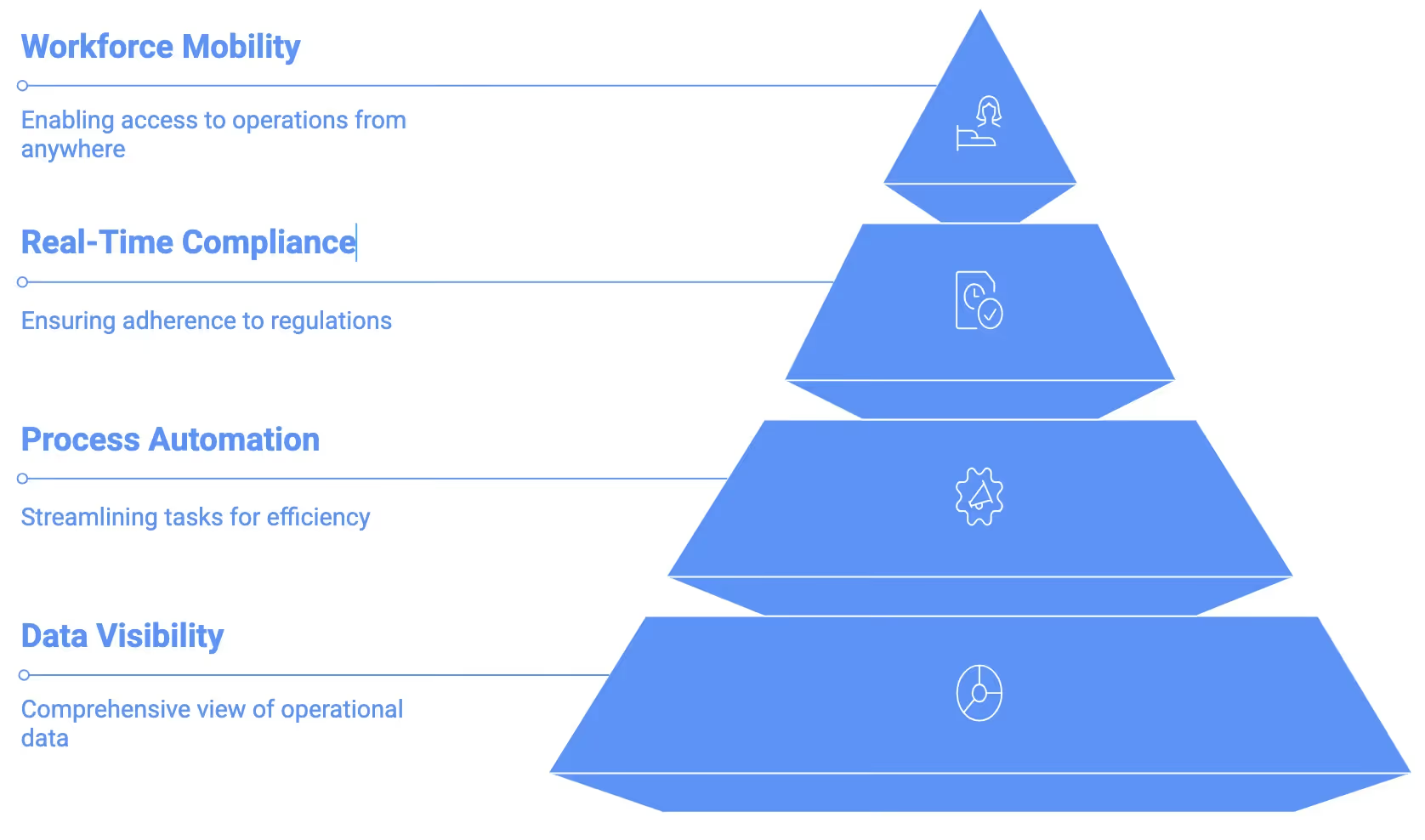
Let’s look at each in more detail:
1. Data visibility
Frontline operations and workforce experience require a unified, permissioned system of record for all credentials and decisions. This system should normalize artifacts (such as hashes, timestamps, and responses) and make them accessible through dashboards and exports. Key performance indicators (KPIs) like median time-to-activate, exceptions by cause, and audit-discovery time should be prioritized and treated as first-class metrics.
2. Process automation
Implement agentic workflows to automate decision-making and cascade decisions, moving beyond simple screen automation. This involves one-touch data capture, parallel verification, and automatic approvals for low-risk scenarios. Exceptions should be routed to a prioritized queue.
3. Real-time guidance and perpetual compliance
Integrate real-time guidance and perpetual compliance into all processes. Every automated decision requires a traceable record including the actor, inputs, rule/model ID, confidence, outcome, and human override rationale.
Jurisdictional obligations, such as AEDT notices, data retention windows, and public audit summaries, should be implemented as configurable toggles within the system, eliminating the need for code changes. Incorporate a 72-hour compliance sprint capability to allow for rule modifications during a season, ensuring the ability to demonstrate the rationale behind such changes.
4. Dynamic workforce allocation and credential management:
Leverage role and geo-specific rules to facilitate the safe and rapid redeployment of personnel. By treating credentials as attributes (e.g., skill X, license Y, expiration Z), this model enables instantaneous matching of workers to shifts, triggers renewal notifications, and prioritizes internal redeployment over immediate external hiring.
To operationalize this framework, you'll need three key artifacts: a responsibility map, a ruleset library (defining role/geography logic), and a KPI Dashboard (tracking the five key performance indicators).
Pro tip: Begin with a small-scale implementation, focusing on one role or region, and expand only once the time-to-activate and manual-hours targets are met.
The playbook in action: A 90-day sprint
Run the program as a short, measurable operations project to prove value and create momentum for scale.
The pilot structure
- Scope: One role, one region, one owner, 90-day clock.
- Sponsorship: CHRO or Head of Ops.
- Owner: A single activation owner (product/ops lead) with authority to change rules and escalate vendors.
- Team: Cross-functional, including CS, Engineering, and Legal (for sign-off)
Before starting, set clear pass thresholds, e.g., 70% median activation vs. baseline. Key KPIs are: Median Time-to-Activate, Invalid-Document Rate, Manual Review Hours per 100 Hires, Candidate Drop-off During Preboard, and Audit Exceptions / Discovery Hours.
When the pilot hits its gates, scale deliberately, reusing ruleset templates and maintaining the same governance cadence.
Pro tip: Here are few of the pitfalls to avoid
- Running too many pilots simultaneously.
- Ignoring candidate UX.
- Assuming one vendor integration solves every verification need.
- Letting legal sign-off creep to the end of the timeline.
Your repeatable advantage
To boost profit margins, it's crucial to integrate disparate frontline operations. This can be achieved through a strategic playbook that emphasizes visibility, automation, compliance, and mobility. By shifting from yearly, reactive measures to a proactive, scalable approach, organizations can gain a sustained advantage. This institutionalization is supported by a responsibility map, a comprehensive ruleset library, and a real-time KPI dashboard, all of which work to optimize the operational engine.
Ready to stop chasing exceptions and start scaling efficiency? Implement the 90-day sprint and convert your operational friction into a competitive edge.